
A redesign of a member onboarding journey in regulated UK financial services. Reframing a one-size-fits-all welcome around what members actually need to discover.
Most welcome journeys quietly assume the new member already knows what they want, and just needs the instructions handed over. This one made that assumption at scale: a single welcome email, sent to everyone, trying to explain an entire relationship in one go.
I worked this redesign through professionally. It’s a proposal to turn that one-size-fits-all welcome into something that responds to who the member is and where they are. It hasn’t gone live yet, so I won’t pretend it moved a number. What it shows is the thinking: how I read the problem, how I structured the alternative, and the calls I made under real constraints.
The setting is a regulated, multi-product UK financial services environment with a broad and varied membership, which shaped everything from what I could personalise to how carefully certain messages had to be placed.
The problem
The problem wasn’t the email. It was the assumption underneath it.
The starting point was a piece of research I was given. The insight from it was uncomfortable: a lot of members didn’t really recognise themselves as members, and weren’t aware of the wider range of services available to them. They’d opened an account or taken a mortgage, and as far as they were concerned, that was the transaction. The relationship the organisation thought it had wasn’t one the member knew they were in.
I read the existing welcome journey against that finding, and the gap was immediate.
The welcome email was, in effect, a digital reconstruction of the printed welcome booklet handed over at account opening. It tried to say everything about managing an account in a single message. Every feature, every option, every piece of guidance, all at once. It didn’t point members toward the right pages so much as bury them under the lot.
The easy critique is that it was too long. That’s true, but it’s also the symptom, not the problem. The real issue was orientation. The journey was built to answer questions a member already knew to ask, like how do I manage my account, and said nothing about the things the research showed they didn’t know to ask: that they were a member at all, that there were services built around that, that some of those services spoke directly to financial situations they hadn’t connected the dots on yet.
Put plainly: the journey served the organisation’s need to inform over the member’s need to discover. And if you don’t know something exists, you’re never going to go looking for it. The old welcome quietly assumed the member would.
The reframe
The reframe
So the redesign started with a different question: not what the welcome should say, but what it’s for.
The old journey was built to deliver information: to hand over everything a member might need and trust them to find their way through it. The new journey had a different job, to reveal relevance that the member couldn’t have asked for, because they didn’t know it existed.
That’s the whole pivot. Stop treating the welcome as a manual to be handed over, and start treating it as the moment to surface the things a member would never go looking for on their own: the benefits they didn’t know applied to them, the services that spoke to their situation, the questions they hadn’t realised were worth asking.
Everything that follows, from the structure to the sequencing to the decisions about what goes where, is that one idea worked out in practice.
The structure
The structure: a journey that does the discovering
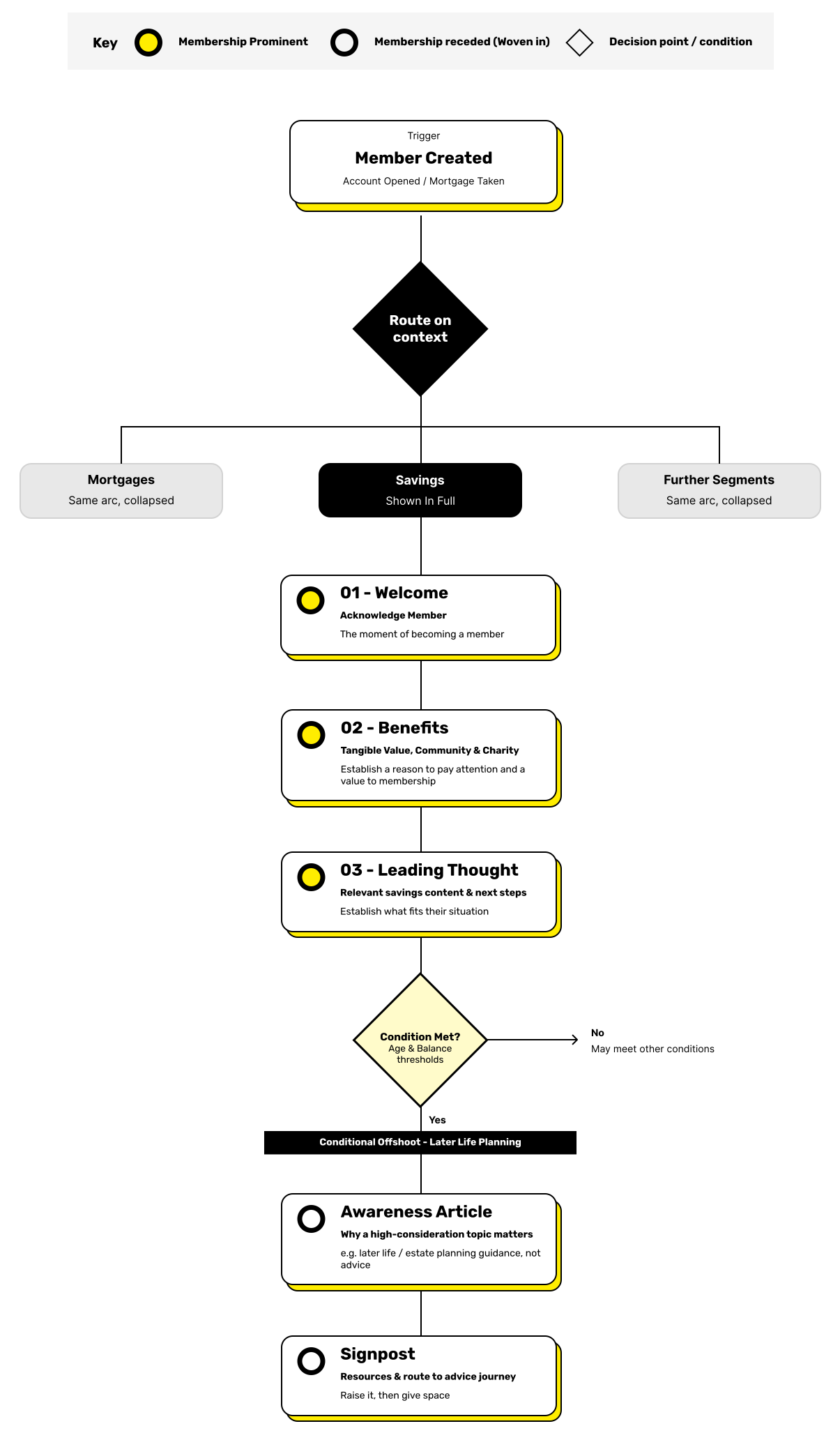
The redesign starts before the first email, with when it’s sent. Rather than a single welcome going out to everyone on the same trigger, the journey keys off the moment that actually matters to the member: the point they become one. Opening an account, taking a mortgage. That’s the moment the relationship genuinely begins, and it’s the moment the welcome should speak to. Timing the journey to real events, rather than blanket-sending, is the first piece of making it feel like it’s for you rather than for everyone.
From there, the journey branches. The map shows the full shape; what matters here is the principle behind it. Each stage surfaces something the member wouldn’t have gone looking for, rather than restating something they already knew.
The opening welcome does the job the research said was missing: it tells members they are members, and what that means, before it does anything else. The follow-up moves to tangible value, the benefits of membership and the community and charity side the old journey buried. Only then does the journey turn to its wider purpose: content and services that speak to a member’s situation, surfacing financial questions they might not have realised applied to them.
There’s a reason the order runs this way, and it’s the part that mattered most to get right. The things most worth surfacing to a member are often the ones they’re least ready to hear cold. Take later-life planning, something like inheritance tax: it’s genuinely valuable to raise, and most people leave it far later than they should. But you can’t open with it. Land “have you thought about inheritance tax” on someone who just opened an account and it’s intrusive, it’s noise, it bounces. A topic like that isn’t a whim decision. It needs space, and it needs the member to have a reason to trust the source before it’s raised at all.
So the sequence isn’t a delivery order, it’s a readiness ramp. Acknowledge that they’re a member. Show them there’s real value here. Only then, once there’s a reason to pay attention, surface the heavier, more considered topics, as a leading thought that opens the door rather than a pitch that forces it. And even then the journey’s job is to make them aware and give them somewhere to go, not to push a decision. It raises the question and steps back, leaving the member the room to look into it in their own time.
That restraint is deliberate. The easy version of this journey would surface everything valuable as early and as often as possible. The better version understands that relevance landed too early stops being relevant and starts being noise.
Underpinning the branching is a set of decision points: the moments where the journey decides which way a given member goes. In this version they run on relatively simple audience signals, but they’re built as the places where richer logic can later live. That seam matters, and I come back to it below.
The throughline is that the journey is doing the discovering for the member. It isn’t waiting for them to know what to ask. It’s surfacing relevance in the order a person can actually absorb it: who you are, why it’s worth your time, and then what specifically might help you.
The decision
The decision that mattered most: where membership belongs
Every project has one call that’s harder than the rest. On this one, it was membership.
The organisation wanted to introduce membership messaging across the journey, reasonably, since the research had shown members didn’t recognise their membership in the first place. But there’s a pull, when something matters to the business, to make everything about it: for membership to become the primary and secondary objective of every message, woven into every email regardless of what that email was actually there to do.
I pushed back on that, and the reason was specific. When membership is pressed into every communication alongside that communication’s own purpose, you get objective collision: each email is now trying to do two jobs at once, and does neither well. The savings email is half about savings and half about membership. The benefits email is hedged with something else. Nothing has a single, clear purpose, so nothing lands cleanly.
So I made the case, through content reviews and walking stakeholders back through the member journey, that membership shouldn’t be spread evenly across everything. It should sit where the member’s context actually makes it relevant, and stay out of the way everywhere else.
In practice, that meant relocating it rather than removing it. Membership leads the welcome, but deliberately, and for a reason that’s easy to misread. The welcome fires at the moment someone becomes a member. Acknowledging that there, at that moment, isn’t the business inserting its agenda; it’s the journey accurately reflecting something that has genuinely just changed for the member. From there it carries into the benefits follow-up, where membership is the point. And then it recedes. By the time the journey reaches its wider content, membership is carried in the language and the framing rather than as a section demanding attention.
That’s the difference between membership front-loaded and membership placed. Front-loaded, it competes with everything. Placed, it shows up where it’s earned and gets out of the way where it isn’t.
The constraint
Working within the constraint, and building for the one after it
The version of this journey I’d have designed in an ideal world routed members on who they actually are: not just which product they hold, but their behaviour, their circumstances, their likelihood of needing a particular kind of help. A member with a certain balance and a certain pattern of activity would land in the journey built for them.
That wasn’t available. The personalisation I could use ran on relatively simple audience signals, not rich individual profiles. So the honest scope of this work is a first version: one that does considerably better than one-size-fits-all, but on coarser logic than the eventual goal.
What I was careful about was making sure the first version didn’t foreclose the second. The decision points in the journey are behaviour-based, which means the condition that sends a member down one path or another is configurable rather than fixed. Today it runs on a single signal. But the platform supports composite conditions, several data points combined into something closer to a real audience profile, and it simply isn’t set up for that yet. The journey is built so that when it is, the richer logic drops into the decision points that already exist.
That distinction is the point. It would have been easy to build something that worked now and had to be torn up later. Designing the simple version so the sophisticated one slots into the same structure is the difference between a first step and a dead end.
Honest limits
What I’d watch, and what I’m not claiming
I’ll be straight about where this sits: it’s a proposal, and it hasn’t gone live. I can’t show you a number that moved, because there isn’t one yet.
What I can tell you is how I’d know it worked. The whole bet is that members will discover relevance they’d never have gone looking for, so the signals I’d watch are the ones that show discovery happening. Whether members engage with the content and services the journey surfaces, rather than letting the welcome wash over them. Whether awareness of the wider service range actually shifts. Whether members drop out of the sequence or stay with it. And underneath all of it, the thing the research first exposed: whether members start to recognise that they’re members, and that it means something.
If those move, the reframe was right. If they don’t, the journey is informing again rather than revealing, and it needs another look.
I’d add one honest note on how this came together. The problem was surfaced by research I didn’t run, and the journey connects to touchpoints I influence rather than own outright. What’s mine is the thinking: reading the research against the existing journey, reframing what the welcome was for, structuring the response, and making the calls about what belonged where, particularly the one about membership, which is the decision I’d stand behind longest.
That’s the work. A one-size-fits-all welcome, turned into a journey designed to meet members where they are. Proposed honestly, constraints and all, and built so the next version is a step forward rather than a restart.